


Ajoutée le 24/10/2026
Identification
| Immatriculation | PT-XFH |
|---|---|
| Constructeur | PIPER |
| Modèle | PIPER L-4 |
| Sous-catégorie | H |
| Numéro de série | 44-79990 |
| Année de construction | 1944 |
| Type | Réplique d'avion |
| État actuel | En état de vol |
Caractéristiques techniques
| Moteur | CONTINENTAL O-200 |
|---|---|
| Puissance | 100 HP (O-200) |
| Marque Hélice | SENSENICH |
| Heures de vol totales | 50 |
Aérodrome de base
| Code OACI de l'aérodrome | SDBN |
|---|---|
| Aérodrome | Associação Recreativa Fazenda Bonanza Airport |
| Ville | Salto de Pirapora |
| Pays | Brésil |
Historique
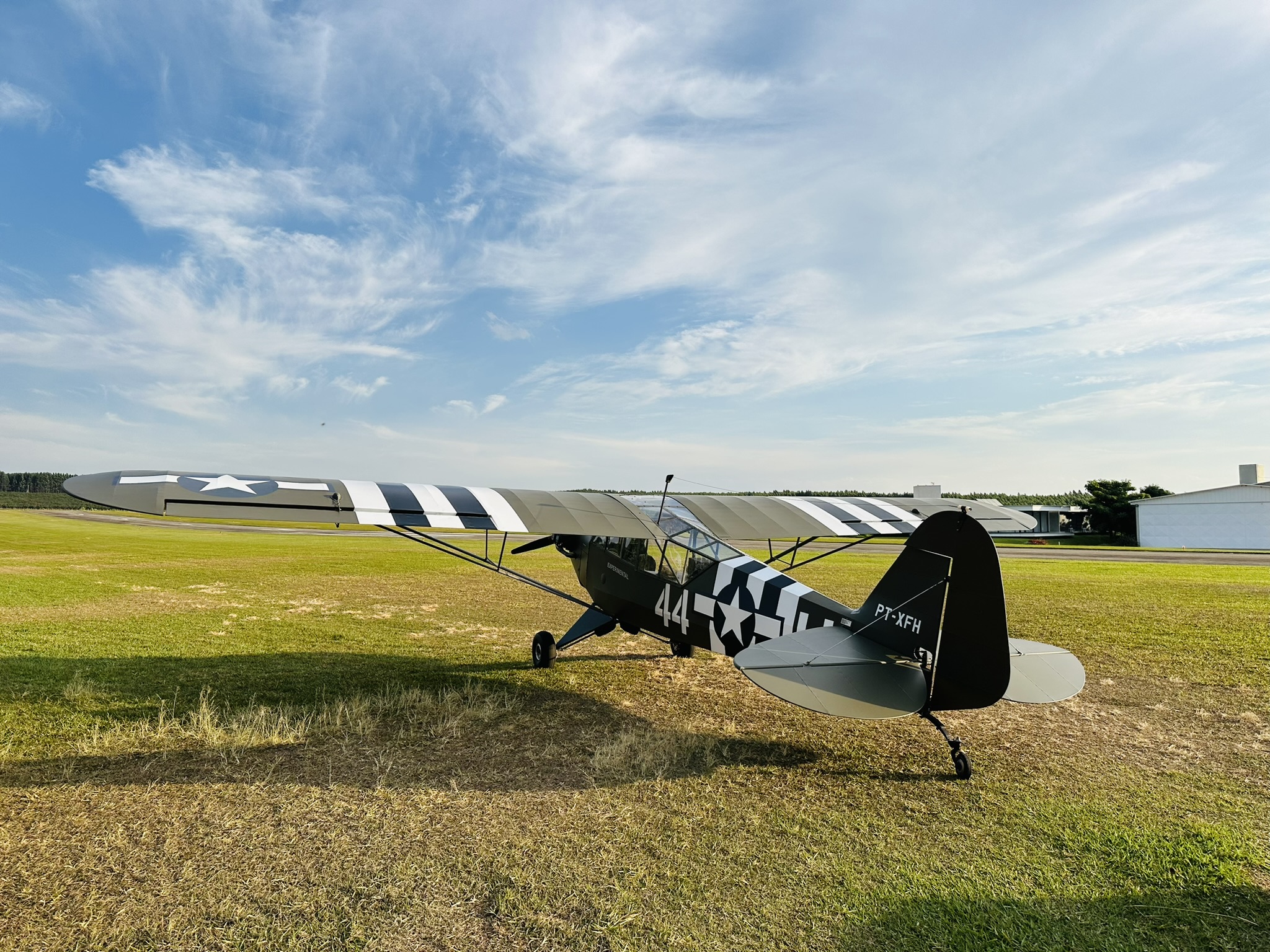
For many years, I had been looking for a Piper Cub to call my own. I mentioned to a few close friends that I was on the hunt—ideally for one tucked away in the back of a hangar, perhaps a bit neglected; the kind of aircraft that is, for all practical purposes, a restoration project. One summer afternoon, one of those friends (Ricardo Soriane) called to say he had found « my » Piper—though, in truth, it wasn’t a yellow Cub, and to be honest, he wasn’t even entirely sure what it was. It turned out to be a replica of a Piper L-4 — a Wag-Aero Sport Trainer (CUBy), built from plans and later modified with enlarged windows, similar to those found on an observation aircraft.
The aircraft was complete, but not in airworthy condition—yet I bought it anyway! We disassembled it and transported it to a workshop belonging to friend of mine.
After a thorough inspection, the owner of the workshop called me and—very tactfully—convinced me to take it completely apart and rebuild it, including replacing the fabric covering. This would allow us to access the aircraft’s « innards » and give us « peace of mind » regarding the entire airframe.
Following a meticulous restoration, the aircraft took to the skies once again. However, since it was originally equipped with a C-65 engine, I decided to swap it for an O-200 for several reasons—better performance with two people on board, operating out of an airfield at 2,500 feet, and so on. Another improvement was the addition of larger wheels and tires.
Most of the period-correct equipment was installed, including the radios—one for reception and another for transmission—as well as the compass, an external antenna, and the black-painted backgrounds on the cockpit instruments. As for the markings and numbering, they belong to an L-4 that was once in the Netherlands—and is now in a museum. The number 44 comes from my mother’s birth date—a bit of poetic license on my part.
I even created an Instagram page for him – @flyingthegrasshopper – follow us! 😉
Où se trouve cet avion
Vous aimez ce site des PIPER ?
34 marques de soutien de la communauté
Être prévenu(e) lors de l'ajout de nouveaux avions